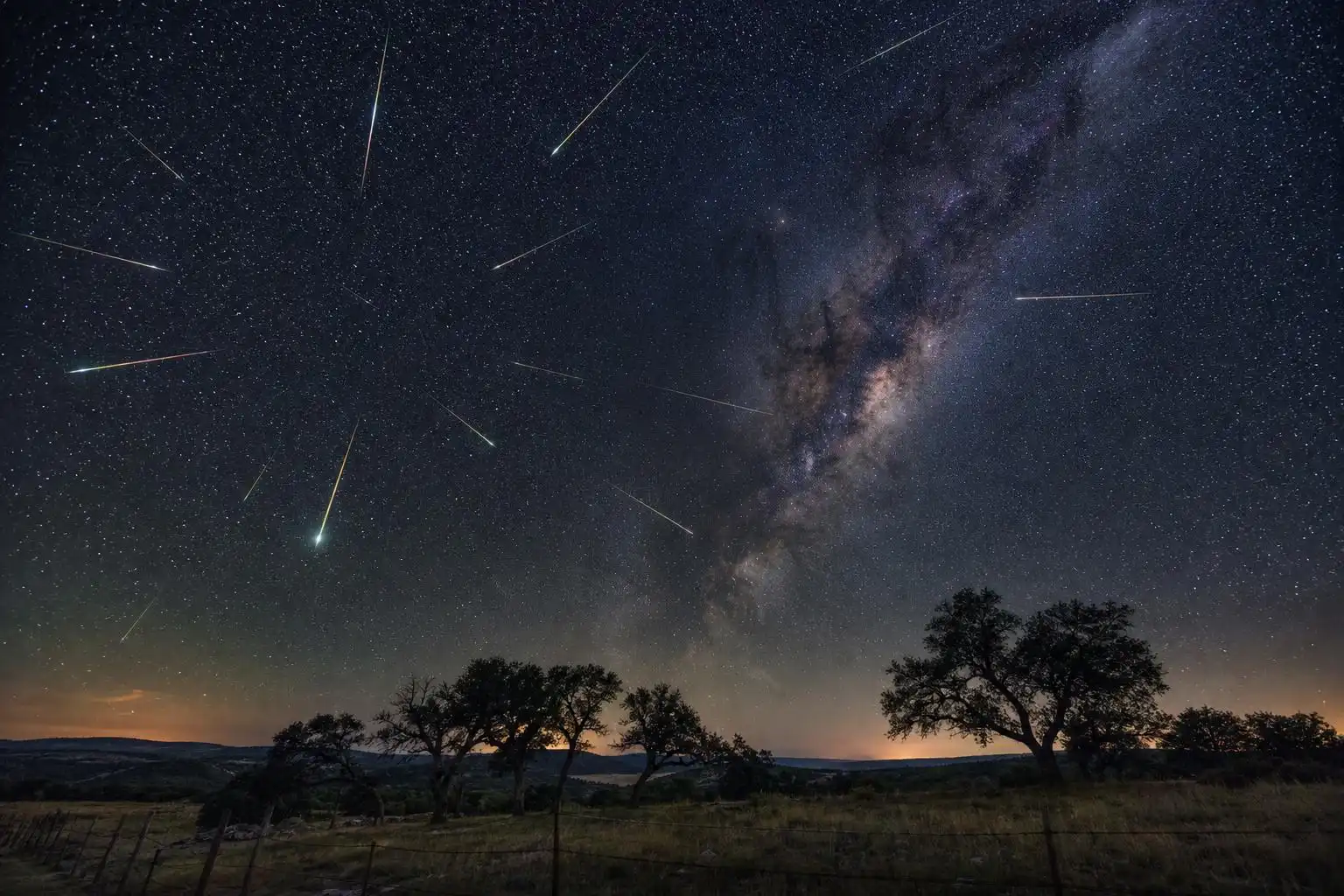

Y’all, August is an absolutely stacked month for skywatchers in Central Texas. I mean it — if there’s one month this year to drag your lawn chair into the backyard and actually look up, it’s this one. We’ve got the Perseid meteor shower, a near-total lunar eclipse, a quirky downtown sunset phenomenon, and multiple community star parties to attend. Let’s break it all down so you don’t miss a thing.
🌠 The Big One: Perseid Meteor Shower (Peak: August 12–13)
Every August, Earth passes through the debris trail left by Comet Swift-Tuttle, and the result is one of the most beloved meteor showers of the year — the Perseids. This year’s peak falls on the night of August 12 into the early morning of August 13, and conditions are looking favorable for Central Texas observers.[7]
From dark rural areas, you can expect to see 50 to 100 meteors per hour at peak. Even from Austin’s suburbs with some light pollution, you’re likely to catch a solid show — especially in the second half of the night. The Perseids are famous for being bright, fast, and occasionally leaving glowing trails behind them. Shooting stars will start appearing shortly after nightfall, but the action really ramps up after midnight and continues until dawn.[7]
Where to watch: The farther you can get from Austin’s city lights, the better. Top spots within reasonable driving distance include Enchanted Rock, Pedernales Falls State Park, Buescher State Park, Colorado Bend State Park, Blanco State Park, and South Llano River State Park.[3] Even a 30–45 minute drive west on US-290 toward the Hill Country will make a noticeable difference in how many meteors you catch.
What to bring: No telescope needed — in fact, leave it at home for this one. Meteor showers are a naked-eye event, and a telescope’s narrow field of view actually works against you. Bring a reclining lawn chair or a blanket, let your eyes dark-adapt for 20 minutes (no phone screens!), and just look up. The radiant point — the spot in the sky from which the meteors appear to originate — is in the constellation Perseus, which rises in the northeast. But meteors can streak across any part of the sky, so just take in the whole dome.
Best viewing time: Midnight to 4 a.m. is your sweet spot.[3]
🌕 Near-Total Lunar Eclipse: August 27–28
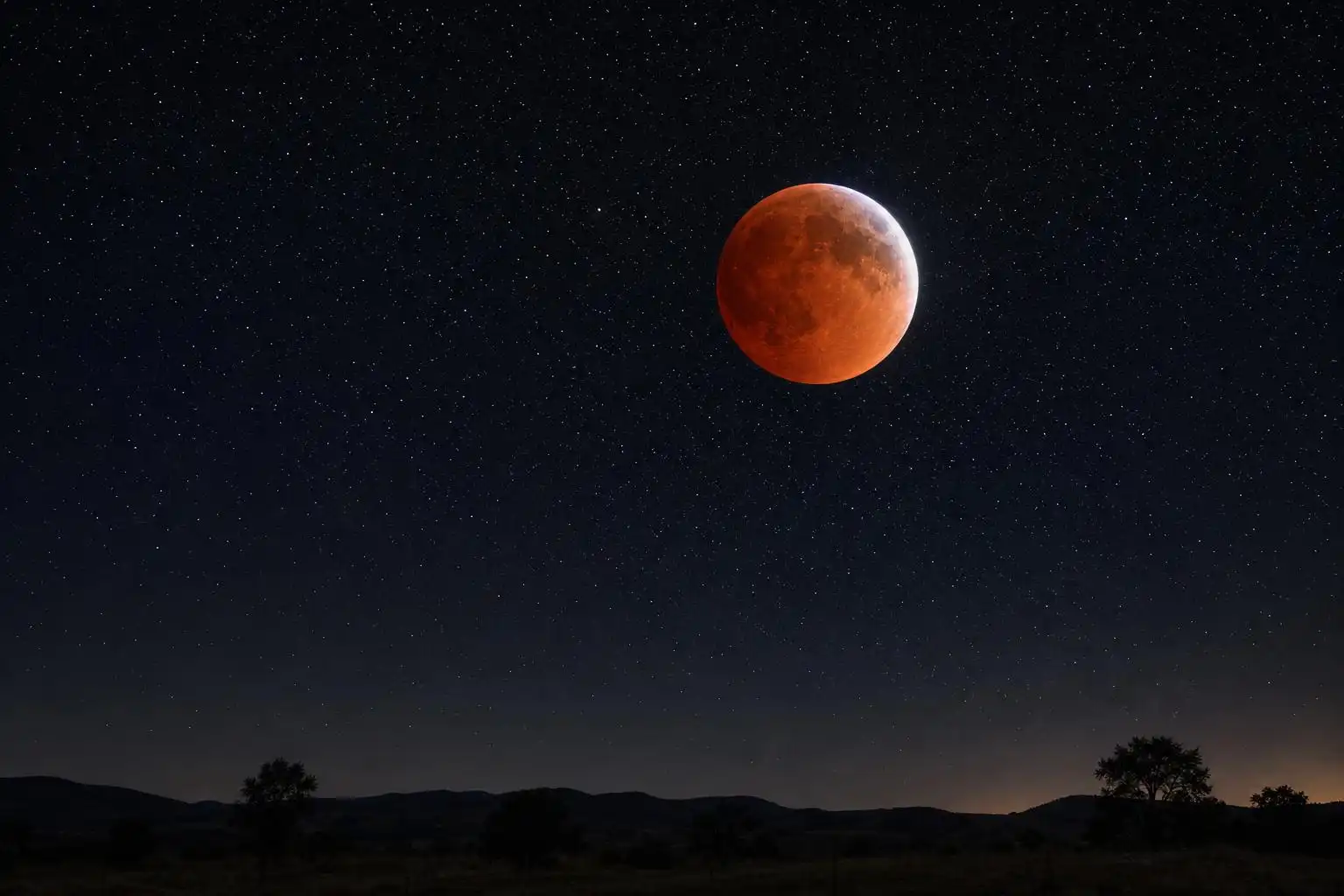
Here’s the second jaw-dropper of the month: a partial lunar eclipse on the night of August 27 into the early morning of August 28, visible right here from Austin with no special equipment required.[7]
Now, “partial” might sound underwhelming — but don’t let that fool you. At peak, 93% of the moon will pass through Earth’s shadow. That’s practically a total eclipse. The moon will take on that gorgeous coppery-red glow that makes lunar eclipses so magical, caused by sunlight being filtered through Earth’s atmosphere as it bends around our planet toward the moon.[7]
The deepest point of the eclipse occurs at 11:12 p.m. CDT on Thursday, August 27 (that’s Thursday night in Austin). This is also August’s Sturgeon Moon — the full moon of August — so it’ll be big and bright before the shadow starts to creep across it. Watch for the moon to rise in the east around sunset on the 27th, and settle in for the show as the night deepens.
This is a fantastic one to share with kids or friends who’ve never watched a lunar eclipse before. No equipment needed, no dark skies required — just step outside and look up at the moon.
🌅 Austinhenge: A Sunset Phenomenon Right Downtown (August 7–9)
Here’s one that’s uniquely Austin, and I love it. Austinhenge — named in the tradition of Manhattanhenge in New York — is when the setting sun aligns perfectly with downtown Austin’s east-west street grid, creating a stunning corridor of golden light that stretches down the avenues.[5]
This happens twice a year, in early August and early May, because downtown’s street grid is tilted slightly northwest to southeast — meaning it misses the fall and spring equinoxes. This year, the alignment is centered around August 7–9, with some streets aligning best on August 7 and others (especially near UT’s campus) on August 8.[5]
To find the exact alignment for your street, check out Hengefinder or a solar planning app. Then just head downtown around sunset, point yourself west along an east-west street, and watch the sun drop right between the buildings. It’s one of those moments that reminds you, as UT astronomy researcher Will Best put it, “that we’re still part of a larger system.”[5]
No equipment needed. Just your eyes and a good street corner.
🔭 Star Parties to Attend This Month
One of the best things about the Austin astronomy community is how generous it is with its time and equipment. Here are some organized events happening this August that I’d highly recommend:
Austin Under the Stars — August 15
The Austin Astronomical Society is hosting its annual public star party at St. Stephen’s Episcopal School starting at 7:30 p.m. This is a fantastic event — volunteers will guide you through planets, galaxies, nebulae, and star clusters through astronomy equipment, and there will be laser tours of the sky throughout the night. It’s BYOT (bring your own telescope), but plenty of scopes will be available on-site if you don’t have one.[3] The AAS has nearly 500 members and their outreach events are always welcoming to beginners.
Stargazing Party at St. Elmo Brewing — August 29
Want to pair your astronomy with a cold craft beer? The Stargazing Party at St. Elmo Brewing on August 29 lets you observe the night sky through telescopes while enjoying Austin’s beloved local brewery scene.[2] This is a low-key, social atmosphere that’s perfect for newcomers to stargazing.
Star Party at Westcave Preserve
The Star Party at Westcave Preserve is another gem — local astronomers share insights about the stars while you view through high-quality telescopes at one of the Hill Country’s most beautiful natural areas.[1] Check Westcave’s website for the exact date, as these events fill up quickly.
🪐 Planets in August’s Sky
After July’s exciting planet parade — when Mars, Saturn, and Uranus lined up in the predawn eastern sky[4] — the outer planets are still putting on a show this month.
Saturn is well-placed for evening and late-night viewing, rising in the southeast in the constellation Aquarius. Through even a basic telescope, you can make out its rings — still one of the most gasp-inducing sights in amateur astronomy. Mars continues to be visible as a reddish point in the morning sky. Binoculars will help you pick it out, though a telescope will show a small reddish disk.
Jupiter is beginning its climb back into prominence in the predawn eastern sky — keep an eye on it as we move into fall, when it’ll be a showstopper.
Tips for August Observing in Central Texas
A few practical notes for August skywatching around Austin:
- Heat and humidity are real. August nights rarely cool below 80°F, and the air can be hazy. Bring water, bug spray, and patience. Haze near the horizon is common, so targets higher in the sky will look sharper.
- The Milky Way is glorious this month. Scorpius and Sagittarius are still riding high in the south during evening hours, and the galactic core stretches overhead. Even from the suburbs, binoculars sweeping through this region will reveal star clusters and nebulae galore.
- Moon phase matters for the Perseids. The good news is that a new moon falls on August 12, giving the Perseids optimal viewing conditions for the peak night of August 12–13.
- Give your eyes time to adjust. Twenty to thirty minutes in darkness dramatically improves what you can see. Avoid looking at your phone screen — use a red-light flashlight instead if you need to check a star map.
August 2026 is genuinely one of the richest months for skywatching we’ve had in a while. From the fireworks of the Perseids to the drama of a near-total lunar eclipse, from the community warmth of Austin’s star parties to the golden magic of Austinhenge at sunset — there is something here for every level of sky enthusiast. Get outside, look up, and let me know what you see. Clear skies, Austin! 🌌
References
- Can’t-Miss Kids Events In Austin In August 2026 — https://austinot.com/kids-events-in-austin-in-august-2026
- Things To Do In Austin In August – 365 Things Austin — https://365thingsaustin.com/things-to-do-in-austin-in-august
- Best places to watch the Perseids meteor shower in Texas — https://www.statesman.com/entertainment/things-to-do/article/perseids-meteor-shower-texas-viewing-22354291.php
- ‘Planet parade’ brings rare view of moon, Mars, Saturn, Uranus to Texas — https://www.elpasotimes.com/story/weather/2026/07/11/moon-mars-saturn-uranus-planet-parade-texas/90886335007/
- ‘Austinhenge’ is back! See the twice annual sunset phenomenon — https://www.kut.org/austin/2026-08-07/austinhenge-downtown-austin-tx-sunsets-astronomy
- August night sky has a rare double feature with eclipse, meteor shower — https://www.yahoo.com/news/science/articles/august-night-sky-rare-double-120958986.html


Leave a Reply