
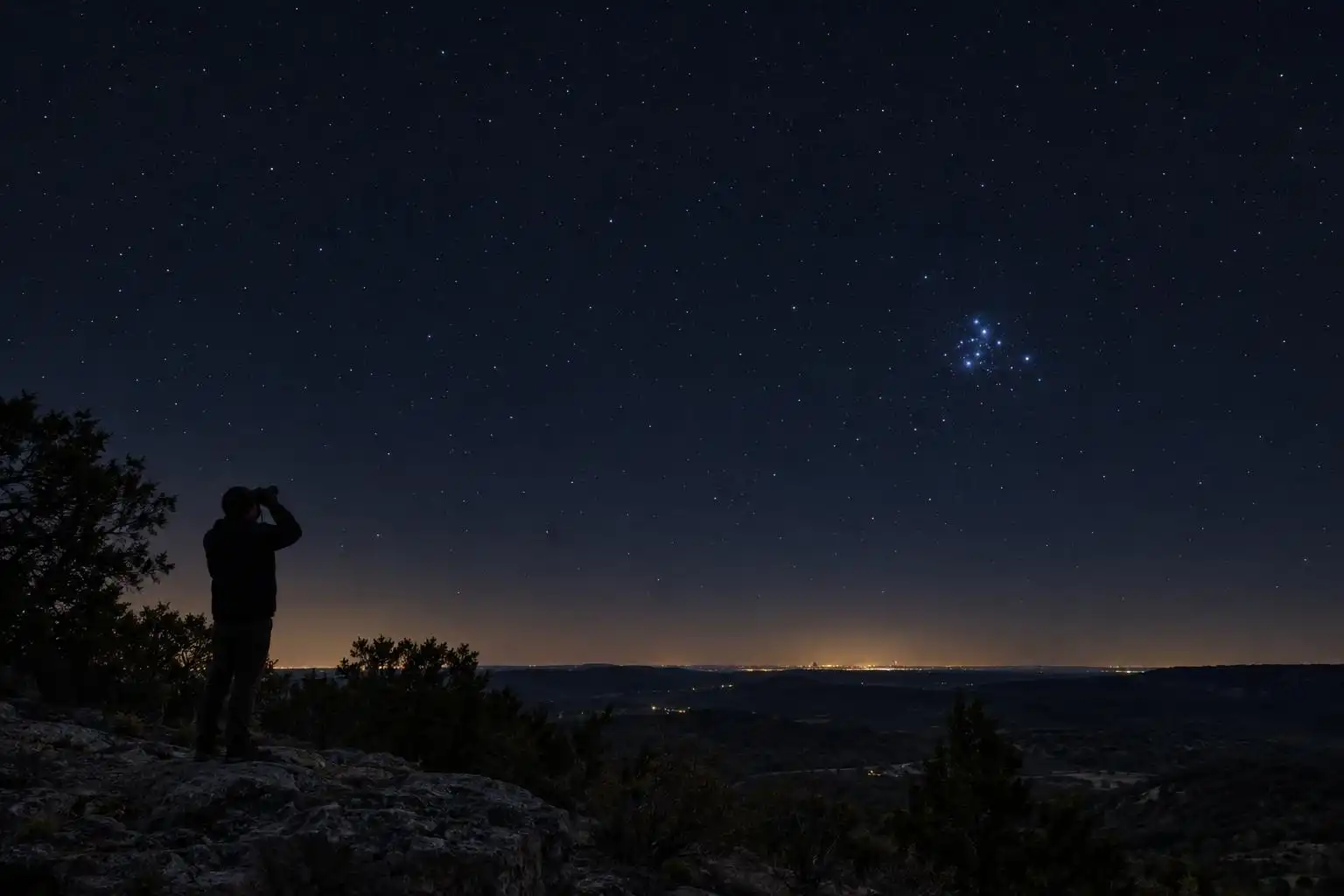

November gives Austin stargazers two different skies in one evening. Look south after dinner for Saturn and the last easy-to-find autumn constellations; stay out later, and winter’s bright stars begin climbing in the east. Better still, the new Moon around November 9 leaves several evenings this week especially dark.
All times below are Central Standard Time. From a backyard around 30°N latitude, start looking at about 7 p.m., when the sky has grown dark enough for faint targets. You can enjoy most of this guide with your eyes alone or a pair of binoculars.
Plan around the Moon
The darkest stretch of November falls roughly from November 7 through 13, centered on the new Moon around November 9. This is your chance to hunt for the Andromeda Galaxy or take a short trip beyond Austin’s brighter neighborhoods. The Moon returns as a thin crescent low in the southwest after sunset during the following evenings.
Around November 17, the Moon reaches first quarter—when its right-hand half appears lit. It is a lovely target in a basic telescope around dusk: shadows along the boundary between its bright and dark halves make craters stand out. The Moon grows toward full around November 24, washing out faint galaxies but making the bright stars and Saturn no less worth finding.
Catch Saturn before the evening gets late
At about 8 p.m. in mid-November, look toward the south for Saturn, roughly halfway from the horizon to straight overhead. It looks like a steady, pale-yellow point rather than a dramatically different sort of star. Its position among the relatively faint stars of Pisces makes it easier to identify if you first check a current sky chart.
A basic telescope can show Saturn as a tiny disk with its rings, though the view will be much smaller than any photograph. Give the planet a few minutes in the eyepiece; brief moments of steadier air often reveal more than your first glance. Try earlier in the month if you can, as Saturn shifts toward the southwest and sets earlier as November goes on.
If you’re awake before dawn, Jupiter offers a second planetary outing. Look high in the southern sky around 5 a.m. Its brightness makes it hard to mistake, and binoculars held steadily may show some of its four large moons as tiny points beside it.
Follow the autumn stars into winter
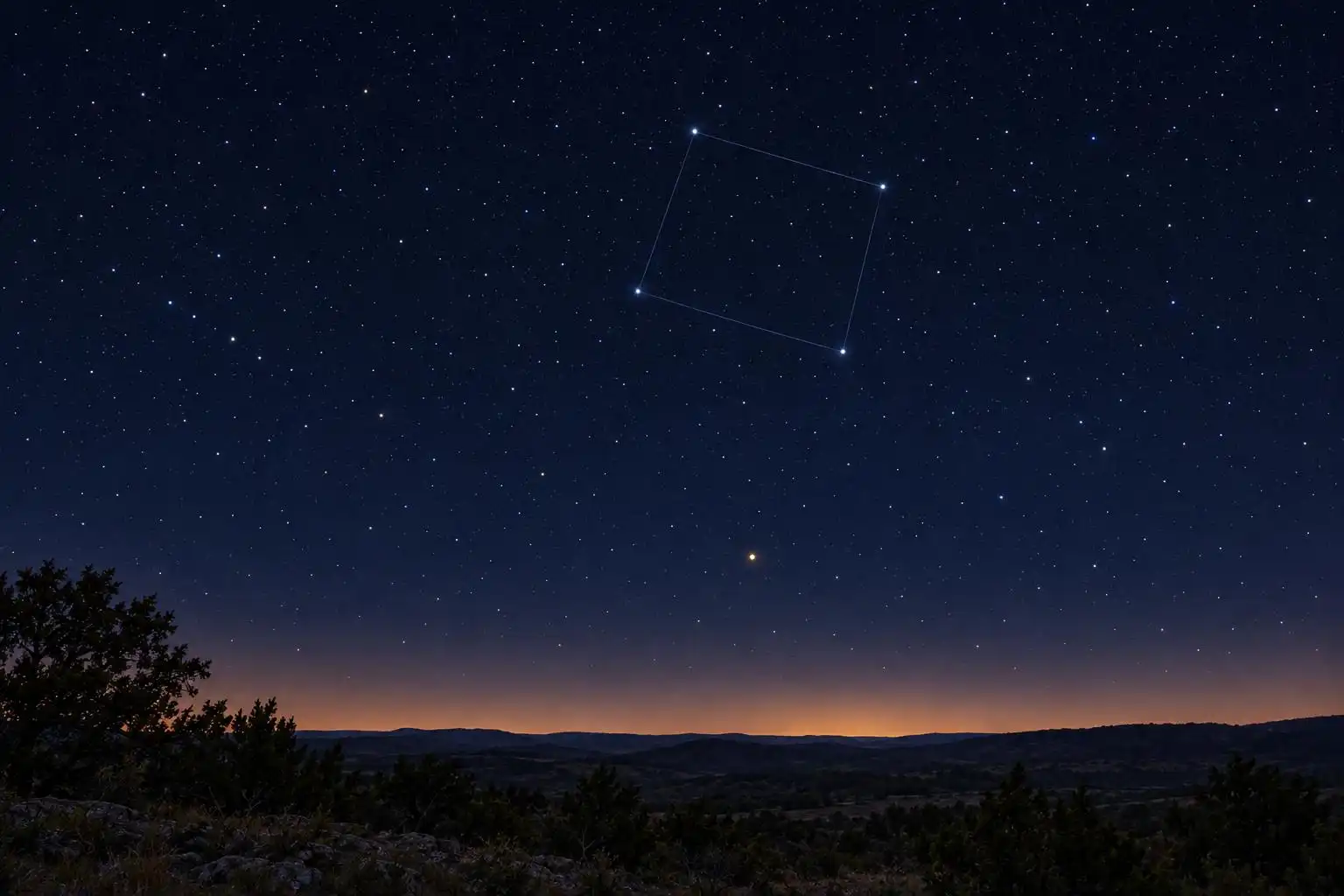
Around 8 p.m., the Great Square of Pegasus sits high toward the south, with the constellation Andromeda extending northeast from one corner. Under a genuinely dark sky, the Andromeda Galaxy looks like a faint, elongated smudge. Binoculars make it much easier to pick out. Let your eyes adjust to the dark, then scan a little to the northeast of the Great Square rather than expecting a photograph-bright spiral.
For a simpler binocular target, look east at the compact sparkle of the Pleiades, or Seven Sisters, in Taurus. By about 9 p.m. they are comfortably above the horizon. Sweep around the cluster as well as across it: binoculars show a lovely gathering of stars too wide to fit easily in many basic telescopes.
Orion rises later, low in the east by roughly 9 p.m. in mid-November and much better placed after 11. Find its three evenly spaced Belt stars; below them hangs the Sword, where binoculars can reveal the Orion Nebula as a soft patch of light. These times are approximate, so allow for buildings, trees, and changes over the course of the month.
Give the Leonids a pre-dawn try
The Leonid meteor shower is worth watching around the night of November 17–18. The Moon will be near first quarter, so its light should be less troublesome after it sets. For the best chance, go outside between about 2 a.m. and dawn, when Leo—the constellation the meteors appear to stream from—has risen higher in the east.
Leave the binoculars indoors for this one. Meteors can streak across any part of the sky, so choose a safe spot with a wide view, settle in, and look away from nearby lights. Don’t count on a storm; on a typical year, patience matters far more than a prediction of spectacular numbers.
Find a darker view—and know what crossed it
A trip into the Hill Country can make the difference between merely locating Andromeda and enjoying the dark sky around it. Austin-area stargazing guides list state and county parks and dark-sky communities as possibilities, but check access hours before you drive: a good daytime destination is not necessarily open after dark.[2]
One modern surprise is a row of moving lights. Closely spaced satellites, including Starlink groups, can briefly resemble a procession of stars. Visible passes depend on your location and the satellites’ changing orbits, so check a current pass forecast rather than planning around a fixed nightly time.[5] Then turn back to the Pleiades: they’ll still be waiting in the east.
References
- Best Stargazing Spots Near Austin in the Texas Hill Country — https://austinot.com/stargazing-near-austin
- Starlink Tracker: Find Starlink Satellites Tonight | Satellite Train Schedule 2026 — https://starwalk.space/en/news/spacex-starlink-satellites-night-sky-visibility-guide


Leave a Reply
You must be logged in to post a comment.