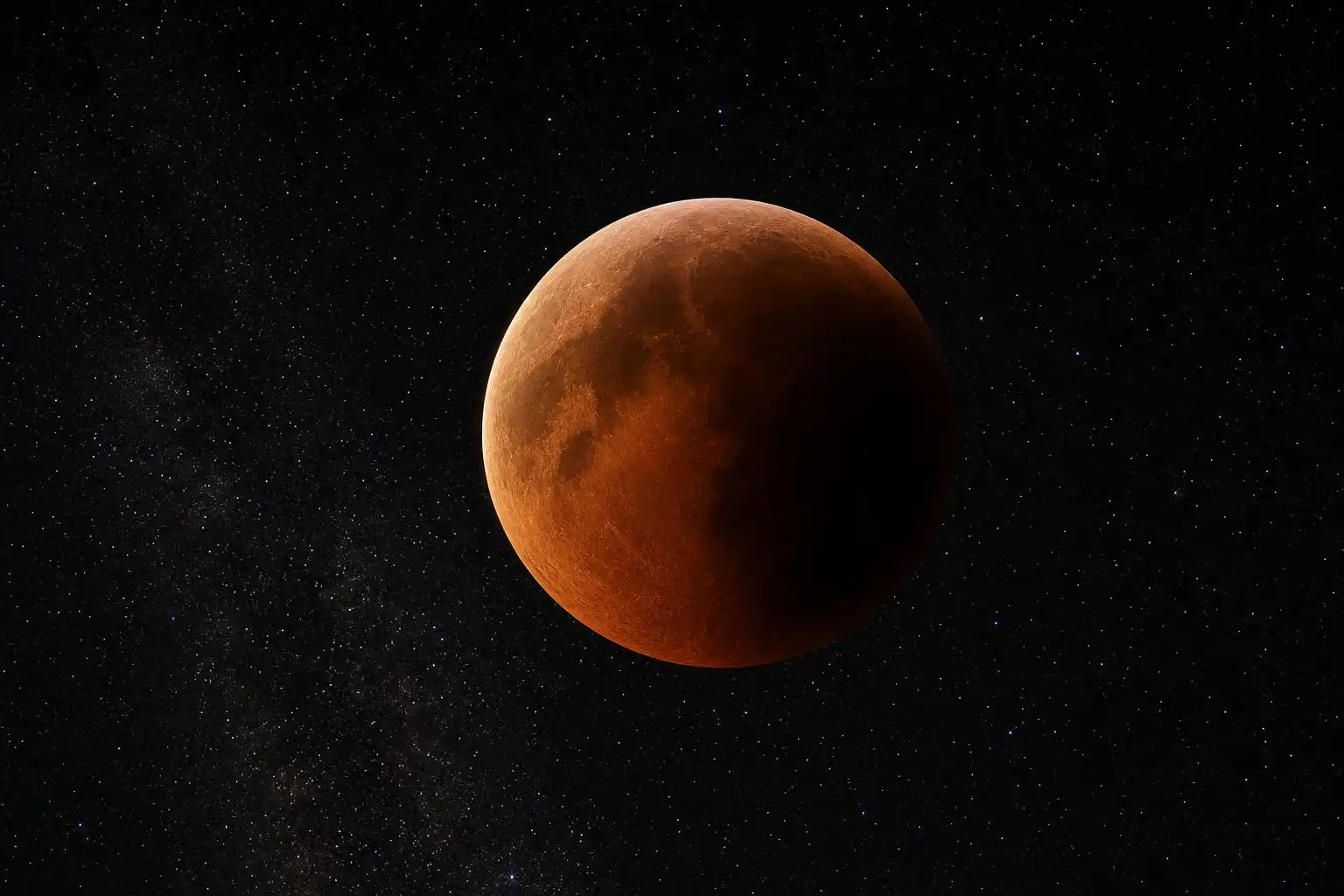

Friends, what a month August was. If you were outside with your eyes on the sky — and I know many of you were — you witnessed one of the most event-packed astronomical months Central Texas has seen in years. We had a total solar eclipse, a six-planet parade, the Perseids, and a deep partial lunar eclipse to close it all out. Let’s recap what happened, talk about what you may have missed, and look ahead to what September has in store for backyard observers here in Austin.
The August 27 Partial Lunar Eclipse: A Near-Total Blood Moon
Let’s start with the most recent big event. On the night of Thursday, August 27, the penumbral phase of the eclipse began at 8:23 PM CDT, with the partial phase starting at 9:33 PM CDT — and the result was absolutely stunning.[1]
This wasn’t just any partial eclipse. At maximum coverage, about 96% of the moon’s illuminated face was swallowed by Earth’s umbral shadow, turning the bulk of the lunar disk a gorgeous rusty-red color.[3] That’s about as close to a total lunar eclipse as you can get without technically calling it one. If you were watching, you know exactly what I mean — the moon looked like a smoldering coal hanging in the southeastern sky.
Why does the moon turn red during an eclipse? It’s the same physics that gives us red sunrises and sunsets. As sunlight passes through Earth’s atmosphere, shorter blue wavelengths scatter away, and the longer red and orange wavelengths bend around the edge of our planet and fall onto the lunar surface. The moon is essentially lit by every sunrise and sunset on Earth happening simultaneously. That’s one of my favorite facts in all of astronomy, and it never gets old.
The penumbral phase of the eclipse finally ended at 2:02 AM CDT on August 28,[5] meaning dedicated observers who stayed up late got several hours of eclipse action. If clouds got in the way for you — Austin weather being what it is in late August — I’m sorry. There will be more eclipses ahead, I promise.
The August 12 Planet Parade and Solar Eclipse: A Triple-Header for the Ages
Rewind a couple of weeks to August 12, which was genuinely one of the most remarkable single days in recent astronomical memory. Three major events converged:[4]
- A six-planet alignment stretched across the pre-dawn and dawn sky
- The Perseid meteor shower peaked on the night of August 12–13
- A total solar eclipse was visible from a narrow path crossing the Arctic, Greenland, Iceland, Spain, and northern Portugal[2]
From Austin’s latitude (about 30°N), we didn’t get the total solar eclipse — that path stayed well to our north and east. But the planet parade was something else entirely. If you were up before dawn on August 12 with binoculars, here’s what you could have hunted down:
- Jupiter was near the Beehive Cluster (M44) in Cancer, very low on the eastern horizon. This was a challenging target — you needed a flat, unobstructed horizon and binoculars to have any chance of picking out the cluster’s faint stars against the brightening sky.[4]
- Uranus was near the Pleiades and Hyades in Taurus. Uranus itself is never easy to spot, but those nearby star clusters make that whole region of sky a joy to sweep through with binoculars, and they serve as excellent landmarks to orient yourself.[4]
- Mars was near M35, an open star cluster in Gemini — with the best pairing visible on August 14. This was probably the most rewarding pairing of the bunch for binocular users — Mars was bright enough to find easily, and M35 is a genuinely beautiful cluster once you’ve got it in the eyepiece.[4]
- Mercury made a close pass near the Beehive Cluster on August 14, a challenging but rewarding target for anyone with a flat eastern horizon and patience.[4]
If you missed any of this, don’t beat yourself up. These events reward the prepared, and now you know what to look for next time planets wander near famous deep-sky objects.
A Word on Solar Eclipse Safety (For Future Reference)
Since we just had a major solar eclipse event, I want to take a moment to emphasize something I can’t say enough: never look at the sun without proper solar filters. This applies to naked-eye viewing, binoculars, and telescopes alike. Permanent eye damage can happen in seconds, and it’s entirely preventable.[7]
For telescope users: fit your solar filter or projection equipment to the scope before pointing it at the sun, and cap any finderscopes. Only remove the filter once the telescope is pointing away from the sun.[2] We’ll have future solar events to observe, and I want all of you around to enjoy them safely.
What to Watch in September from Austin
Okay, so August was a tough act to follow. But September has its own charms, and after all the excitement, there’s something genuinely lovely about settling into the quieter rhythms of the autumn sky. Here’s what I’ll be watching:
The Milky Way’s Last Great Stand
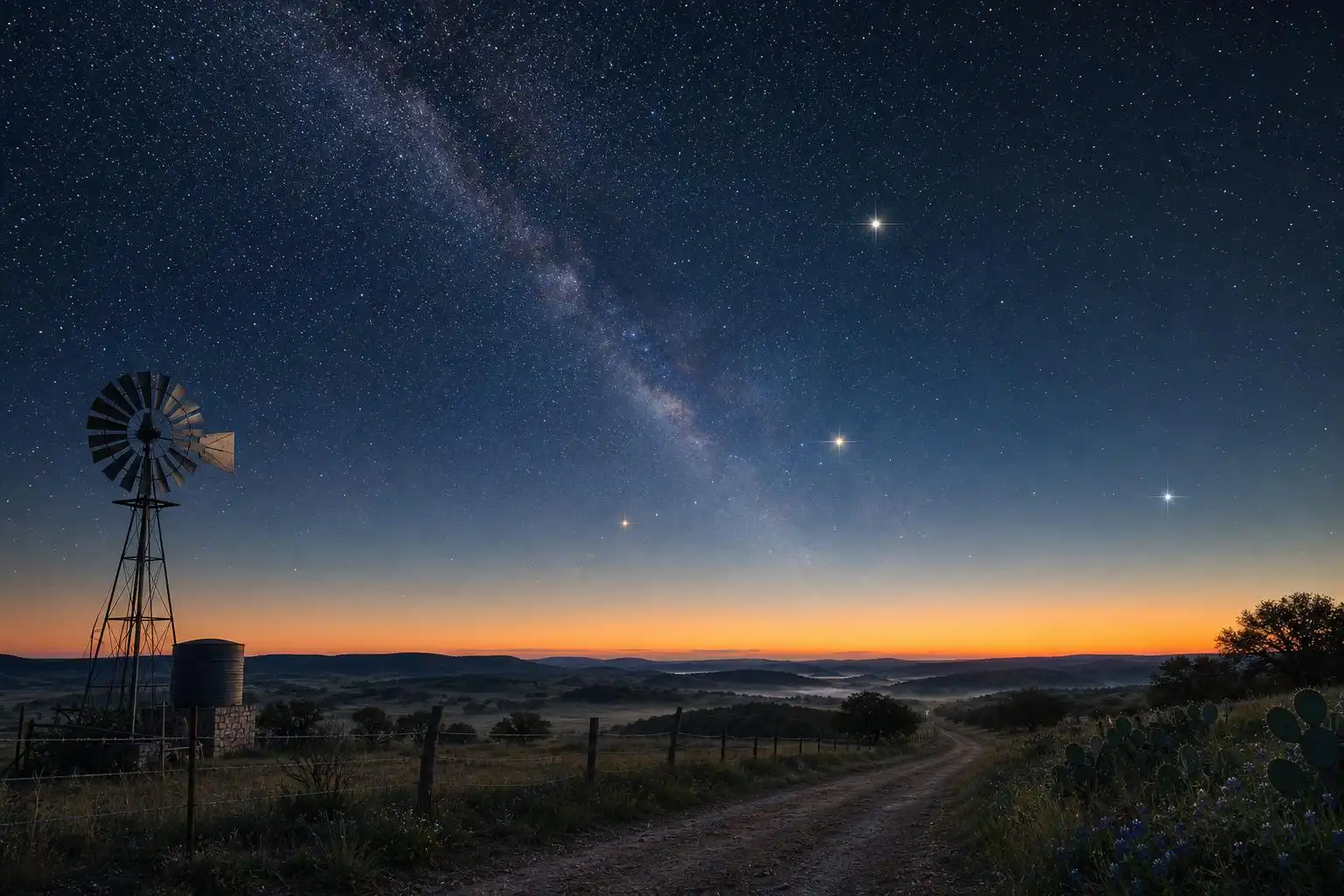
September is your final reliable month to see the Milky Way core from Central Texas before it drops too low in the southwest after dark. Head out to a dark site — Enchanted Rock, Pedernales Falls, or anywhere well away from Austin’s light dome — around 9–10 PM and look toward Sagittarius and Scorpius in the southwest. The core is still there, still glorious, but it’s setting earlier each night. Soak it in.
Saturn Climbing Higher
Saturn is becoming an increasingly rewarding evening target in September. Look for it rising in the southeast after dark, in the constellation Aquarius. Even a modest 60mm refractor or a basic 4.5-inch reflector will show you the rings clearly, and September offers better viewing geometry than August did. This is the planet I recommend to every first-time telescope user, without exception. Nothing prepares you for the moment those rings snap into focus.
The Andromeda Galaxy in Prime Position
By mid-September, the Andromeda Galaxy (M31) is rising high in the northeast by late evening and is perfectly placed for binocular viewing. From a dark site, you can spot it with the naked eye as a faint smudge — but through 7×50 or 10×50 binoculars, it becomes something genuinely moving. You’re looking at light that left that galaxy over 2.5 million years ago. Let that sink in for a moment.
To find it: locate the Great Square of Pegasus in the east, then star-hop up through the constellation Andromeda. M31 will be a soft, elongated glow that you’ll notice immediately once you’re in the right spot.
The Autumn Milky Way and the Summer Triangle
The Summer Triangle — Vega, Deneb, and Altair — is still high overhead in September evenings, and the Milky Way runs right through it. This is a beautiful region to sweep with binoculars: star clusters, nebulae, and dense star fields reward patient observers. Look especially for the Coat Hanger asterism (Collinder 399) in Vulpecula, just south of Cygnus. It’s one of my favorite binocular targets of the year — a perfectly obvious little cluster that looks exactly like its name.
Tips for September Observing in Austin
- Best viewing times: 9:30 PM to midnight local time gives you dark skies and comfortable temperatures (finally — highs should be dropping into the 90s and eventually the 80s by late September, which means nights in the 60s and 70s).
- Moon phase: Check your calendar for new moon dates and plan your dark-sky sessions accordingly. A bright moon will wash out faint targets like the Andromeda Galaxy and Milky Way.
- Dress in layers: It sounds absurd in Texas, but late September nights can actually get chilly once you’re sitting still for an hour. Bring a light jacket.
- Let your eyes dark-adapt: Give yourself at least 20 minutes away from phone screens and white lights before you start hunting faint objects. Red flashlights are your best friend.
August was extraordinary. But the sky keeps turning, and September has its own quiet wonders waiting for you. Grab those binoculars, find a dark patch of Central Texas sky, and let your eyes adjust. I’ll see you out there.
Clear skies, Austin!
— Stella
References
- Lunar Eclipse Thursday Night: The Science Behind the Blood Moon and How to See It — https://cbsaustin.com/news/local/lunar-eclipse-thursday-night-the-science-behind-the-blood-moon-and-how-to-see-it
- August 2026 solar eclipse – Path map, key locations and timings | BBC Sky at Night Magazine — https://www.skyatnightmagazine.com/advice/12-august-2026-total-solar-eclipse-guide
- Will the clouds break in time for Austin to see partial lunar eclipse tonight? — https://www.statesman.com/weather/article/austin-lunar-eclipse-thursday-night-weather-22406102.php
- August 12 Planet Alignment: Viewing Guide — https://starwalk.space/en/news/planetary-alignment-august-12-2026
- Deep partial lunar eclipse on August 27-28, 2026 — https://earthsky.org/astronomy-essentials/partial-lunar-eclipse-of-the-august-27-28-2026
- How to watch a solar eclipse safely: tips here — https://earthsky.org/astronomy-essentials/how-to-watch-a-solar-eclipse-safely


Leave a Reply
You must be logged in to post a comment.