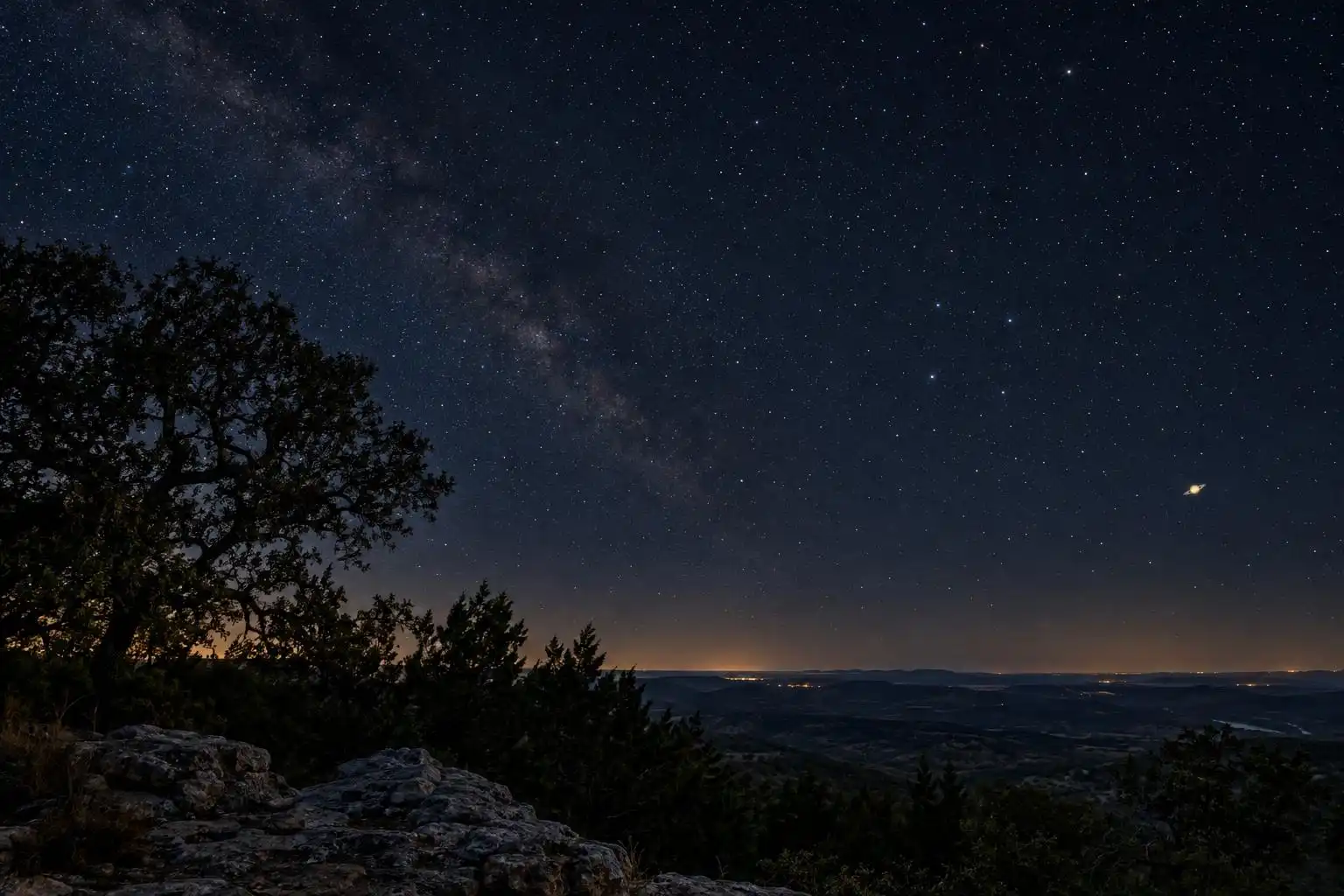

October gives Austin stargazers a welcome trade: earlier sunsets and more comfortable evenings, even if clear skies still require a little luck. Saturn is ready for an after-dinner look, the Pleiades are returning, and a nearly moonless weekend offers a chance to hunt for faint autumn sights. You can enjoy most of it with your eyes or binoculars.
Pick your nights by the Moon
The first half of October is the better stretch for faint objects. The Moon was a very thin waning crescent around the October 9 peak of the Draconid meteor shower, leaving the evening sky dark.[5] Although that peak has passed, the next several evenings are still inviting for clusters and the Andromeda Galaxy. Try to get outside after twilight ends, around 8 p.m. CDT.
As the Moon grows brighter, make it the target instead of fighting its glare. Around October 18–20, aim a basic telescope along the boundary between its bright and dark halves. The low-angled sunlight there brings out craters and mountain shadows. Near the October 25–26 full Moon, save your faint-object hunting for another night and enjoy a bright lunar rise instead.
Saturn takes the evening shift
Look southeast at about 8:30–9 p.m. Saturn should be a steady, pale-yellow point roughly halfway from the horizon to overhead. It climbs higher toward the south as the evening goes on, making later views through a basic telescope less vulnerable to the wobbly air near the horizon. If the rings look small at first, give your eyes a few minutes and wait for moments when the image steadies.
Jupiter and Mars belong to the morning shift. Before dawn, Jupiter is the brighter beacon in the east; Mars is dimmer and may take a little more searching. An open eastern view helps. If you heard about the Moon passing in front of Jupiter on October 6, that event is already over—and from Austin, observers were in the reappearance-only zone. Jupiter emerged from behind the Moon after the pair rose; its disappearance was not visible here.[4]
Try the Orionids before dawn
The Orionid meteor shower peaks around October 21–22.[5] Unlike August’s Perseids, this is a show that rewards a very early alarm. The Moon will be bright during much of the evening, so your best chance is the hours before dawn, after it has dropped low or set. Check the Moon’s setting time for your observing spot before you head out.
Find an open, dark place and look broadly overhead rather than staring at Orion. By the predawn hours, Orion’s familiar three-star Belt is high toward the south. Meteors can streak across any part of the sky; binoculars narrow your view too much to help. Give yourself at least 30 minutes outdoors, and treat every meteor as a bonus. Activity varies, and Austin’s city lights will hide the faintest streaks.
Follow the autumn star trail
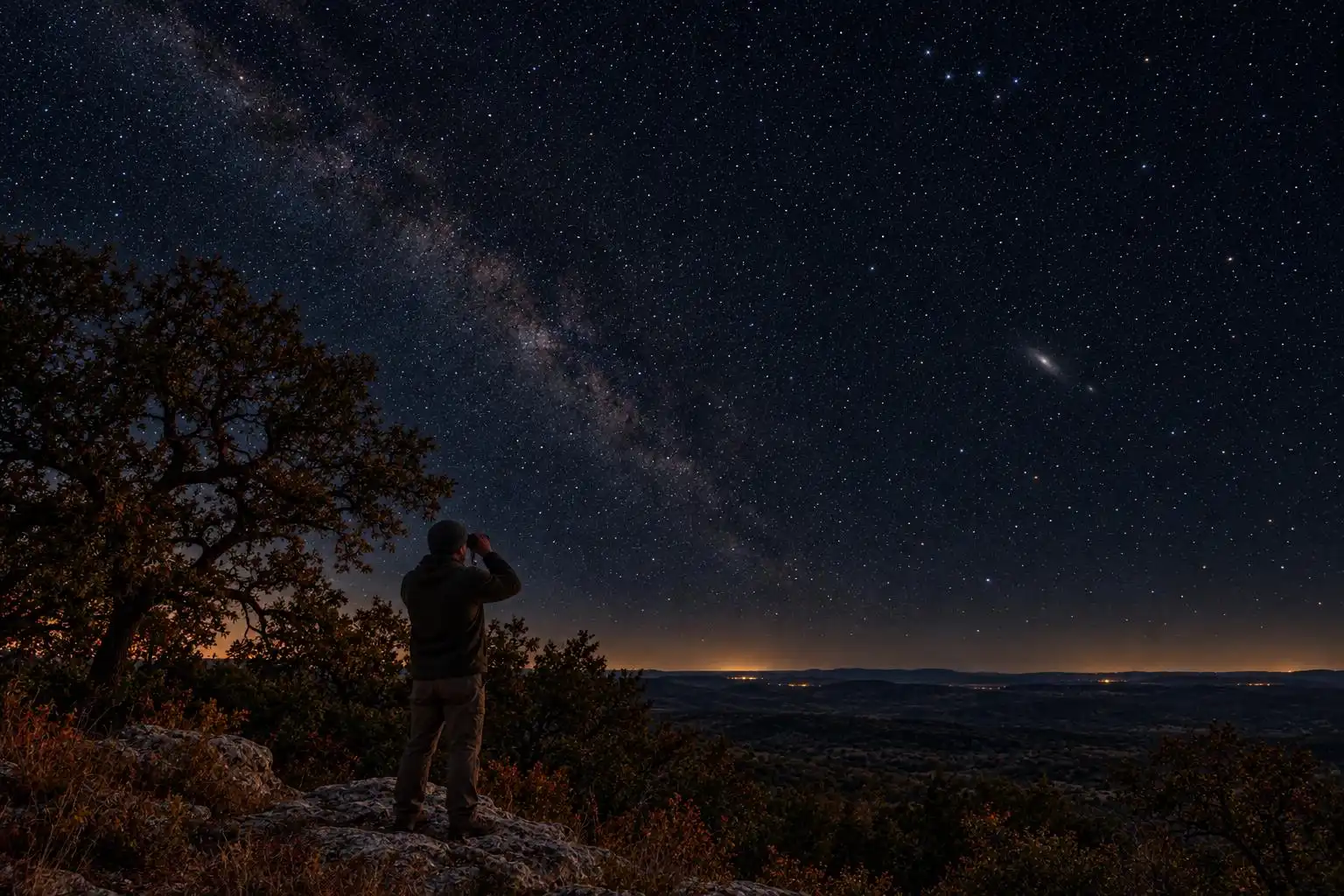
For a satisfying binocular tour, start around 9 p.m. with the large Square of Pegasus high in the eastern half of the sky. From its northeastern corner, follow the bright stars of Andromeda away from the Square. In a dark sky, the Andromeda Galaxy appears nearby as a soft, elongated smudge—not the spiral photograph you may have seen, but light from another galaxy reaching your own eyes.
Next, turn northeast to Cassiopeia’s unmistakable W shape. Sweep slowly through the star-rich region between Cassiopeia and Perseus; binoculars reveal clusters that are easy to miss while navigating by eye. Later in the evening, look east for the compact, sparkling Pleiades above the horizon. They’re a lovely binocular target even from a backyard with some nearby lights.
If you miss summer’s stars, glance west. The Summer Triangle is still prominent after dark, with bright Vega lower than it was a month ago. This overlap is October’s charm: you can say goodnight to the summer sky and greet the winter stars in a single outing.
Make a darker night of it
October’s dark evenings are a good excuse to leave Austin’s brightest lights behind. Enchanted Rock, about 100 miles from the city, is an International Dark Sky Park; check park reservations, access hours, and nighttime rules before making the drive.[3] You needn’t travel that far for Saturn or the Moon, though. A backyard with its lights switched off is enough to begin.
Texas Dark Sky Month also has a local television connection: Austin PBS scheduled an October 7 repeat of The Stars at Night, a documentary about astronomy, storytelling, and protecting the night sky.[1] The broadcast date has passed, but its message suits every October observing session. The fewer lights we shine upward, the more of that star-filled sky we can share.
References
- A Month for Stargazing: Austin PBS Presents The Stars at Night October 2026 – The El Paso Times — https://www.elpasotimes.com/press-release/story/206308/a-month-for-stargazing-austin-pbs-presents-the-stars-at-night-october-2026
- Best Fall Road Trips Austin — https://austinot.com/fall-road-trips-austin
- See the Moon occult Jupiter October 6 — https://www.astronomy.com/observing/the-moon-occults-jupiter-october-6
- Meteor Shower Calendar 2026: Peak Times and Dates | The Old Farmer’s Almanac — https://www.almanac.com/content/meteor-shower-calendar


Leave a Reply