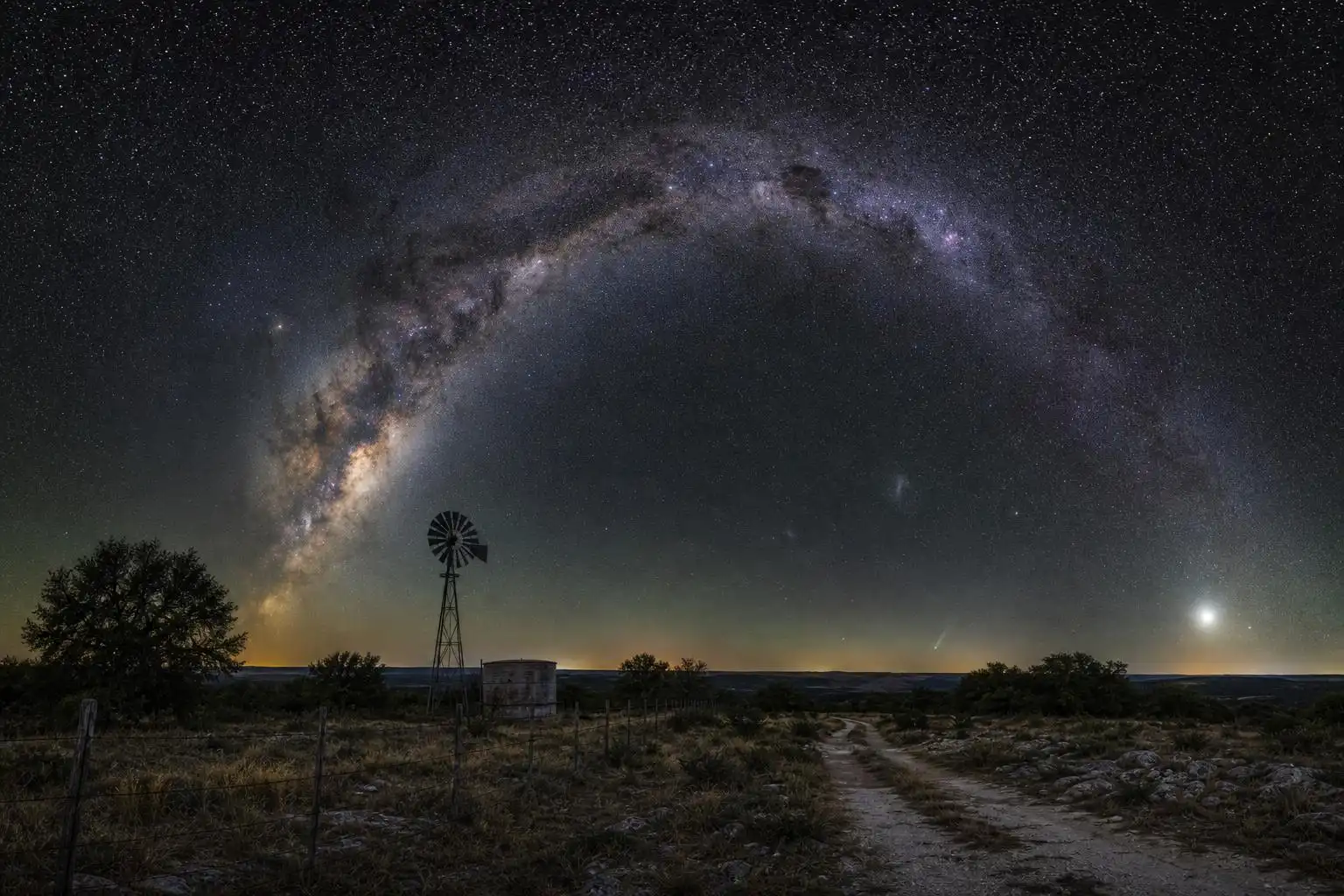

Y’all, I am genuinely giddy about what’s waiting for us above the Texas Hill Country this month. July 2026 is shaping up to be one of the best stretches of stargazing we’ve had all year — and the timing couldn’t be more perfect. The glare of June’s full Strawberry Moon is finally fading, a gorgeous dark-sky window is opening up, and the planets are practically putting on a parade. Grab your binoculars, slap on some bug spray, and let’s talk about what to look for.
🌙 Moon Phase: Your Stargazing Calendar
Here’s the deal with the moon this month, and it matters more than people realize. The last-quarter moon arrives on July 7, which means evening skies start getting beautifully dark right away.[1] From that point until the new moon on July 14, you’ve got roughly a 12-night window of increasingly dark skies — this is your prime time, Central Texas. Use it.
After July 14, the moon begins brightening again, eventually rising as the full Buck Moon on July 29.[2] Beautiful to look at, but it will wash out fainter targets. So plan your deep-sky sessions for the first two weeks of the month.
✨ Venus and the Star Regulus: A Close Encounter in the West
On the evening of July 8–9, step outside after sunset and look toward the west-northwest horizon. You’ll immediately spot Venus — it’s impossible to miss, blazing like a beacon roughly 15–20 degrees above the horizon as twilight fades. Now here’s the fun part: Venus will be passing within just one degree of Regulus, the brightest star in Leo the Lion.[1]
Think about what you’re actually seeing when you look at that pair. Venus is our neighboring planet, a cloud-shrouded world about 100 million miles away. Regulus? That hot, fast-spinning star is roughly 79 light-years from Earth. Same patch of sky, wildly different distances. That’s the kind of thing that makes my brain do a happy somersault.
Through binoculars, the contrast is stunning — Venus will appear as a tiny, brilliant white disk, while Regulus will show a blue-white pinpoint. Don’t miss this one. It’s a quick, low-effort “wow” moment even from your driveway.
Tip for Austin observers: Face west-northwest around 9:00–9:30 p.m. CDT. Venus will be low, so find a spot with a clear horizon — a hill, an open field, or even a rooftop works great.
🔴 Mars in the Morning: A Pre-Dawn Treat
If you’re an early riser (or a night owl who hasn’t gone to bed yet), Mars is your reward. Throughout July, Mars is visible in the southeast before sunrise, hanging in the constellation Taurus.[2]
The showstopper morning is July 11, when a slim 13%-lit waning crescent moon swings close to Mars and the ruddy giant star Aldebaran, with the gorgeous Pleiades star cluster sparkling nearby — all in the same binocular field of view.[1] Set your alarm for around 4:00 a.m. CDT and look toward the east-northeast. The crescent moon will be your guide — once you find it, Mars and Aldebaran will be right there with it.
Mars will appear as a warm, reddish-orange dot. Aldebaran, the “eye” of Taurus, is also red-orange — and it’s a fun game to try to tell them apart! Mars will be slightly brighter and won’t twinkle the way Aldebaran does (planets generally hold a steadier light than stars). The Pleiades, meanwhile, will look like a tiny smudge of diamonds to the naked eye and absolutely gorgeous through binoculars.
🪐 Saturn: Ring Season with a Twist
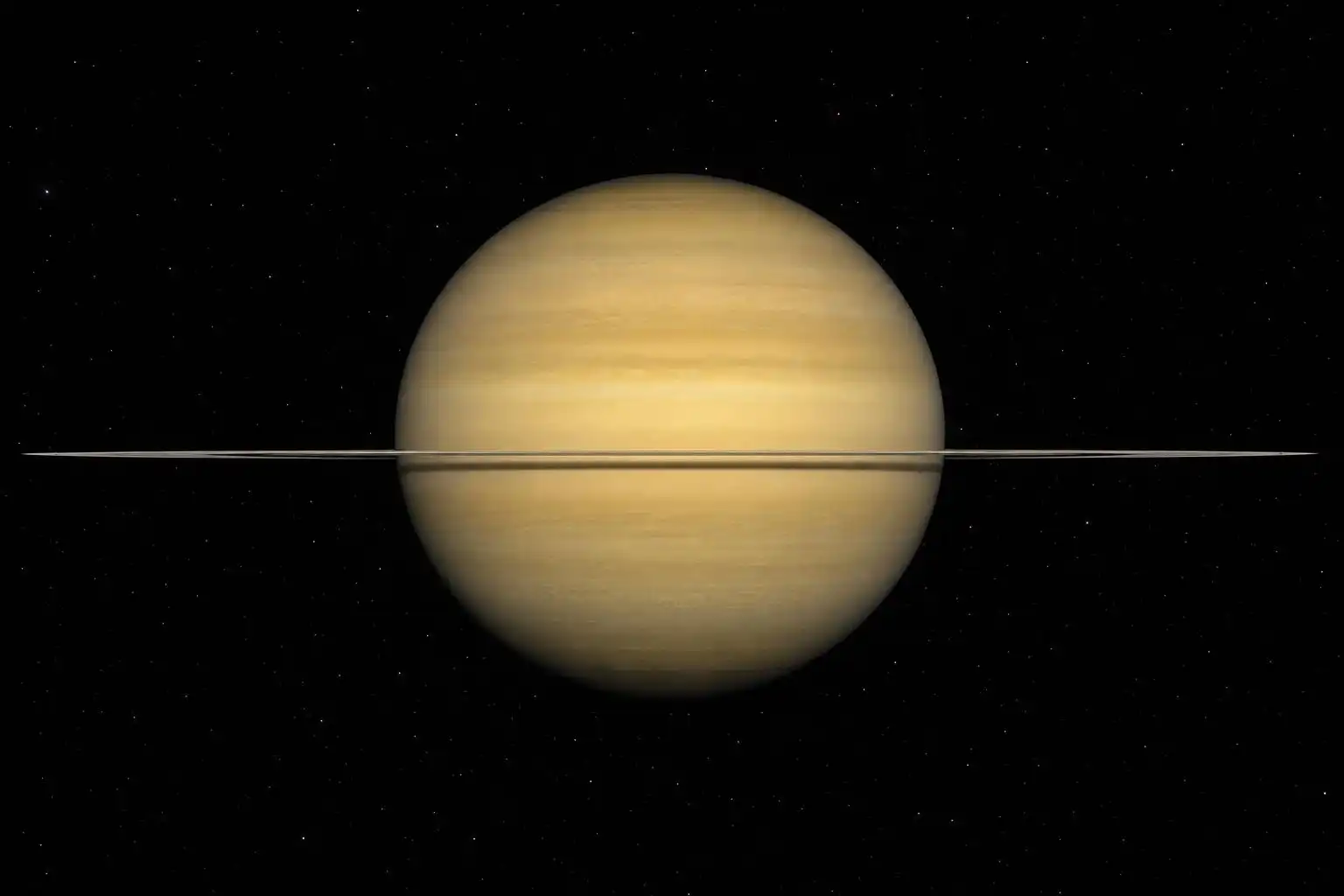
Saturn is also rising in the southeast during the predawn hours all month long, and this year it’s doing something particularly interesting through a telescope.[2] NASA notes that Saturn’s rings are currently at an unusually thin angle as seen from Earth — they’re nearly edge-on — making this a uniquely rewarding (and humbling) telescopic target.[7]
If you’ve only ever seen Saturn with the rings tilted wide open, this is a completely different look. The planet will appear more “naked” somehow, the rings reduced to a thin silver line. It’s a reminder that our solar system is always in motion, always changing the view. Point your telescope at Saturn in the southeast before dawn and take a long look.
☄️ Comet 10P/Tempel 2: A Fuzzy Visitor Worth Hunting
Here’s something that doesn’t come around every summer: a binocular comet. Comet 10P/Tempel 2 is making its return to the inner solar system this month — it swings by on a roughly 5.5-year orbit — and the dark skies around the July 14 new moon give us our best shot at spotting it.[7]
To be clear: this isn’t a dramatic naked-eye comet with a sweeping tail. But through binoculars or a small telescope, you can find it as a small fuzzy glow near the constellation Capricornus, possibly with a brighter central knot and a short, fan-shaped tail.[7]
Here’s how to hunt it from Central Texas:
- When: Start looking about 45–60 minutes after sunset, once the sky is fully dark
- Where: Face south-southeast. Capricornus is a mid-sized constellation that looks a bit like a lopsided triangle or arrowhead
- How: Use binoculars first to sweep the area. You’re looking for something that doesn’t look quite like a star — a soft, slightly smeared glow rather than a sharp point
- Best dates: July 12–16, centered on the new moon
Getting out of Austin’s light dome will make a huge difference here. Try driving 30–45 minutes west toward the Hill Country — anywhere around Wimberley, Blanco, or Fredericksburg will give you dramatically darker skies.
🌌 The Milky Way: July Is Prime Time
Speaking of dark skies — let’s talk about our galaxy. July is arguably the best month of the year to see the Milky Way from Central Texas, and those same dark nights around the July 14 new moon are your golden window.[7]
By around 10:00–11:00 p.m. CDT in mid-July, the galactic core — the densest, most brilliant part of our galaxy — is riding high in the south, arching overhead through the Summer Triangle (look for the bright stars Vega, Deneb, and Altair nearly overhead in the east). From a dark site, the Milky Way is not subtle. It’s a river of light spanning the whole sky, with dark dust lanes and star clouds you can trace with your naked eye.
From Austin proper, you’ll catch a hint of it on a clear, humid-free night. But trust me: make the drive. The Milky Way from a dark Hill Country hillside in July is one of the most moving things you will ever see. Bring a blanket, lie on your back, and just… look up.
🌠 Meteor Showers: Two for the Price of One
July is actually a double meteor shower month, and both are worth knowing about.
The Perseid meteor shower officially kicks off around July 17 — yes, the famous Perseids start that early![1] They won’t peak until mid-August, so rates are still low this month, but you may catch a few early Perseid streaks in the pre-dawn northeast sky. Something to watch for.
The Southern Delta Aquariids begin on July 18 and run through August 21, with a possible peak around July 30.[2] Their radiant point — the spot in the sky where meteors appear to originate — is in the constellation Aquarius, which rises in the southeast after midnight. These aren’t a firehose of meteors, but on a good night from a dark site you might see 15–20 per hour near the peak. Look south after midnight and be patient.
The bad news: the July 29 full Buck Moon will interfere with the Delta Aquariid peak on the 30th. The good news: any clear night in the July 18–27 window, before the moon gets too bright, is worth a look.
🗓️ Quick-Reference Calendar for Austin Observers
| Date | Event | When & Where |
|---|---|---|
| July 7 | Last Quarter Moon | Midnight onward — dark evenings begin |
| July 8–9 | Venus near Regulus | After sunset, west-northwest |
| July 11 | Moon, Mars, Aldebaran & Pleiades | ~4:00 a.m., east-northeast |
| July 11–12 | Dawn alignment: Moon, Mars, Saturn, Uranus | Pre-dawn, southeast |
| July 14 | New Moon | Darkest skies — comet & Milky Way night! |
| July 17 | Perseids begin (early) | Pre-dawn, northeast |
| July 18 | Southern Delta Aquariids begin | After midnight, southeast |
| July 29 | Full Buck Moon | Rises at sunset |
Final Thoughts: Get Outside This Month
I know July in Austin means heat, humidity, and the occasional thunderstorm rolling through at the worst possible moment. But the sky rewards the persistent. Check your weather app obsessively. When you see a clear night coming — especially in that first two weeks of the month — make a plan and go.
You don’t need fancy equipment for most of what’s on this month’s menu. Venus near Regulus? Naked eye. The Milky Way? Naked eye. The crescent moon with Mars and the Pleiades? Binoculars are perfect. Comet 10P/Tempel 2 and Saturn’s rings? That’s where your small telescope earns its keep.
The universe is putting on a show. All you have to do is look up.
Clear skies, Austin! — Stella
References
- See The Milky Way At Its Best As Planets Glow: The Night Sky This Week — Forbes — https://www.forbes.com/sites/jamiecartereurope/2026/07/06/see-the-milky-way-at-its-best-as-planets-glow-the-night-sky-this-week/
- Planets, meteor shower, and a Buck Moon: Astronomical events for July 2026 — WESH — https://www.wesh.com/article/planets-meteor-shower-and-a-buck-moon-astronomical-events-for-july-2026-stargazing-astronomy-night-sky-summer/71901124
- What’s Up: July 2026 Skywatching Tips From NASA — Mirage News — https://www.miragenews.com/whats-up-july-2026-skywatching-tips-from-nasa-1703374/


Leave a Reply